
Note: This site participates in the Amazon Affiliates and other affiliate partner programs at no cost to you. Visiting an affiliate partner site may result in this site receiving a commission. For more information visit our Affiliate Disclosure page.
Hiroshima’s historic sites are concentrated in and around the Peace Memorial Park, and they are best understood as a sequence rather than a checklist. This is what each one is, what it holds, and how to plan a visit that does them justice.
The short answer
The core sites are the Peace Memorial Museum, the A-Bomb Dome, and the monuments in the park between them: the Cenotaph, the Flame of Peace, the Children’s Peace Monument and the underground National Peace Memorial Hall. Allow half a day. Take the museum first and the outdoor monuments afterwards.
Peace Memorial Museum
The museum is the centre of any historical visit to Hiroshima. It covers the lead-up to the bombing, the event itself at 8:15 on 6 August 1945, and the aftermath, largely through the belongings and testimony of the people who were there. A renovation completed in 2019 reorganised the exhibits around personal accounts. It is a demanding visit. We spent between one and two hours inside in the morning, and it was somewhat crowded but not terribly so. Tickets (¥200 for adults) are sold at a kiosk in the lobby, with several languages, cash accepted and a printed QR code that you scan at the turnstile. We skipped the audio guide (around ¥400) and read the signs, using Google Translate on our phones for a few images, and found the museum well organized for visitors who do not read Japanese. The mood is somber, so expect to need time afterwards. Go early to be ahead of school and tour groups; at most well-known sites in Japan, crowds tend to start building after about 10 am.
The A-Bomb Dome
The A-Bomb Dome is the ruin of the former Hiroshima Prefectural Industrial Promotion Hall, almost directly below the point of detonation. It was one of the few masonry buildings near the hypocentre left partly standing, and the city chose to preserve it exactly as it was rather than clear or restore it. It became a UNESCO World Heritage site in 1996. You view it from the riverbank path; the interior is fenced off. It is most striking early in the morning or after dark, when the park is quiet.
We walked past the Dome and took several photographs. What affected us most were the outdoor plaques around it, which set photographs of the area before the bombing beside photographs of it afterward. There were many people in the park that day, and it still felt quiet, peaceful and somber. On our visit a survivor of the bombing was standing near the Dome, speaking with tourists who stopped to talk. He spoke in both English and Japanese, shared some photographs and answered questions. It was not an organized talk, just a personal, informal conversation with anyone who was interested. You cannot count on it, but if you come across something like it, stop and listen respectfully.
Only have two days? 2-Day Hiroshima Itinerary →
The monuments in the park
- The Cenotaph for the A-Bomb Victims. (We walked past the Cenotaph, the Flame of Peace and the Children’s Peace Monument with its paper cranes on our visit.) A saddle-shaped arch sheltering the register of names of everyone known to have died from the bombing, added to each year. It is aligned so that you look through it to the Flame of Peace and the A-Bomb Dome beyond.
- The Flame of Peace. Lit in 1964 and intended to burn until the last nuclear weapon on earth is gone.
- The Children’s Peace Monument. A statue of a girl holding a folded crane, for Sadako Sasaki and the child victims. The glass cases around it hold paper cranes sent from all over the world.
- The Peace Bell. One of several bells in the park, and one visitors are invited to ring.
National Peace Memorial Hall
Set slightly apart and partly underground, the Hiroshima National Peace Memorial Hall for the Atomic Bomb Victims is a place of remembrance rather than exhibition. A circular hall holds a panoramic view of the destroyed city rendered in tiles; adjoining rooms hold names, photographs and recorded and written accounts of the dead. It is free, and it is usually the quietest space in the park. We noticed the entrance on our visit but did not go inside, so this description comes from published sources, not our own visit.
Beyond the park
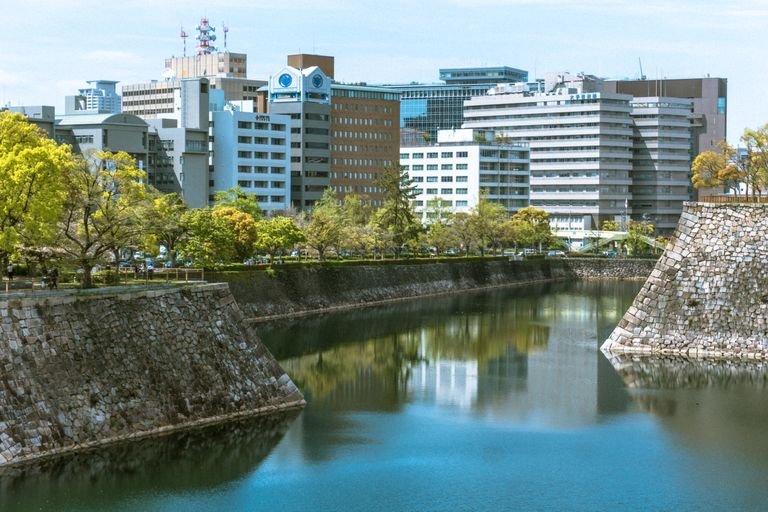
- Hiroshima Castle. The original keep was destroyed in the bombing. The 1958 reconstruction of the keep closed to visitors on 22 March 2026 with no reopening date set, so for now you can walk the grounds and the moat and see the keep from outside.
- Honkawa and Fukuromachi elementary schools. Both have small peace museums in surviving parts of the original buildings, showing the bombing’s effect on the neighbourhood schools. Less visited, quietly powerful.
- The Atomic Bomb hypocentre marker. A modest plaque on a side street a few minutes from the Dome, marking the point above which the bomb detonated.
Planning the visit
Everything above is within walking distance or a short tram ride. Volunteer guides can be arranged in advance through the city and add a great deal of context; audio guides and guided group tours are also available. Approach the sites as you would any memorial: quiet voices, and ask before photographing people.
Frequently asked questions
How long do you need for Hiroshima’s history sites?
Half a day for the museum, the Dome and the park monuments. A full day if you add the Memorial Hall properly, a walk around Hiroshima Castle’s grounds and one of the school peace museums.
Is the Peace Memorial Museum suitable for children?
It is used extensively by Japanese school groups, but parts are graphic. Parents of younger children often do the park and the Memorial Hall and skip or shorten the main museum.
Do you need to book the Peace Memorial Museum?
Not normally. We bought our tickets at a kiosk in the lobby with no booking. In the busiest periods, booking a timed entry online avoids a queue. The park, the Dome and the Memorial Hall are always free and open.
Are there guided tours of the Peace Park?
Yes. Volunteer guides can be requested through the city in advance, and paid group and private tours run daily. A guide is worth it for the connections between the sites that are easy to miss alone.
Where to go next
To fit these into a schedule, see the 2-day Hiroshima itinerary or how long you really need. For the wider case for visiting, read why visit Hiroshima. Everything we have written sits on the Hiroshima hub.
This article is for informational and educational purposes only. Always verify current travel requirements with official government sources before making travel decisions.
Partner resource. We may earn a commissionBook a Hiroshima Peace Park tour (Viator) →