
Note: This site participates in the Amazon Affiliates and other affiliate partner programs at no cost to you. Visiting an affiliate partner site may result in this site receiving a commission. For more information visit our Affiliate Disclosure page.
The Camino de Santiago in Spain and the Kumano Kodo in Japan are the world’s only officially paired pilgrimage routes. Walk a qualifying section of each and you can register as a Dual Pilgrim, a joint program run by the Tanabe City Kumano Tourism Bureau and the pilgrim authorities in Santiago. This is how it works, and how I did it.
The short answer
You qualify by completing:
- at least the last 100 km of the Camino de Santiago on foot, arriving in Santiago de Compostela; and
- any one of five designated Kumano Kodo routes on foot, ending at Kumano Hongū Taisha.
You can do them in either order, with no time limit between the two. Then you register, in Japan at Tanabe or Hongū, or in Santiago at the city tourist office, show your stamped credentials, and receive a certificate and a pin. Registration is free.
What qualifies on the Camino de Santiago
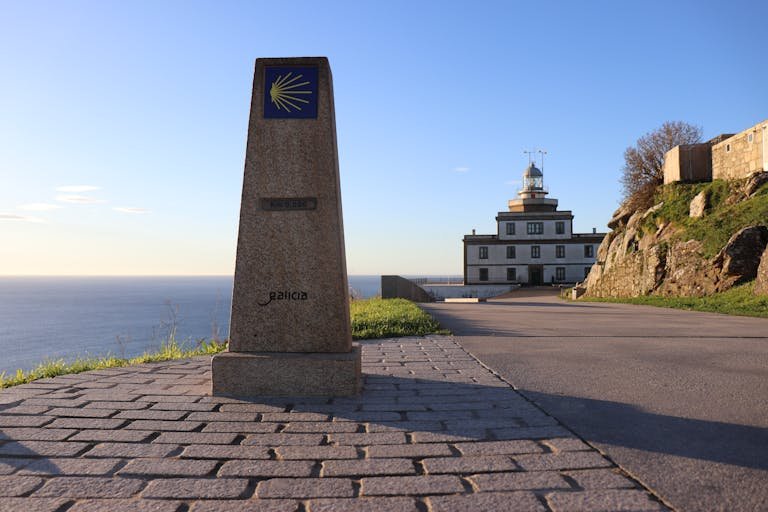
The same standard as the Compostela: walk at least the final 100 km into Santiago de Compostela, carrying a pilgrim credential (credencial) stamped at least twice a day over that last stretch. Most dual pilgrims walk the last 100 km of the Camino Francés from Sarria, or the Portuguese route from Tui or Valença. Cycling the last 200 km earns the Compostela, but the Dual Pilgrim program is built around walking both routes.
For the full rules see the Compostela requirements, and for how the stamps work, Camino stamp culture.
What qualifies on the Kumano Kodo
Five options, all on foot (no bicycles or horses), each ending at Kumano Hongū Taisha where you collect the completion stamp:
- Takijiri-oji to Kumano Hongū Taisha, about 38 km, the classic two-day Nakahechi walk.
- Kumano Nachi Taisha to or from Kumano Hongū Taisha, about 30 km over the Kogumotori-goe and Ogumotori-goe passes, the hardest of the Nakahechi sections.
- Hosshinmon-oji to Kumano Hongū Taisha, about 7 km, plus a visit to the other two grand shrines (Kumano Hayatama Taisha in Shingū and Kumano Nachi Taisha).
- Kōyasan to Kumano Hongū Taisha, about 65 km on the Kohechi, the longest and toughest option.
- An Ōhechi combination, the Ogigahama site, Tōkei-jinja, two or more other Ōhechi coastal-route sites, plus all three grand shrines.
Option three is the lightest on the legs and the usual choice for dual pilgrims short on time.
Still choosing between the two trails? Kumano Kodo vs Camino de Santiago →
How to register
In Japan: at the Tanabe Tourist Information Center, next to JR Kii-Tanabe Station, or the Kumano Hongū Heritage Center beside Ōyunohara. Bring your stamped Kumano Kodo credential and proof you finished the Camino, a photo or digital copy of your Compostela is accepted, so you don’t need the paper certificate with you.
In Santiago: you register at the Turismo de Santiago city tourist office at Rúa do Vilar 63, not the Pilgrim’s Reception Office. Collect your Compostela from the Pilgrim’s Office first, then walk over to Rúa do Vilar with it and your stamped Kumano credential. Opening hours run roughly 10:00-18:00 in winter and 9:00-19:00 in peak season.
What you receive
A limited-edition Dual Pilgrim pin badge, and a completion certificate on washi paper issued in the name of the head priest of Kumano Hongū Taisha. You can also add your name to the online dual-pilgrim register. If you finish at Hongū, there is usually a moment to strike the shrine’s drum to mark the completion.
How I did it
I completed the Camino side twice, both times on the Portuguese Coastal route, and the Kumano side on the Nakahechi, walking in to Hongū and registering at the Heritage Center. I brought my Kumano stamp book and my Camino documents, walked the staff through both routes, and they filled out the certificate and handed over the pin. I went in January, so the completion drum was not set up; the staff told me to come back and play it another time. Doing the registration at Hongū, having finished at Santiago on the far side of the world, is the moment the “dual” idea stops being an abstraction and becomes a thing you actually did.
Planning both
You do not have to walk them close together, people often have years between. If you are planning them as one trip, the practical differences matter. The Camino has dense, walk-up-friendly albergue lodging. The Kumano Kodo has few beds, and you should book everything, accommodation and luggage forwarding, months ahead through the official Kumano Travel system. Our full side-by-side comparison covers terrain, cost, food and character.
Frequently asked questions
Do the Camino and Kumano Kodo have to be done in a certain order?
No. Either order, with any gap of time between. You are a Dual Pilgrim once both are complete.
What is the shortest way to qualify?
The last 100 km of the Camino on foot, plus the 7 km Hosshinmon-oji to Kumano Hongū Taisha section of the Kumano Kodo with visits to the other two grand shrines.
Can I cycle either route for the Dual Pilgrim program?
The Kumano Kodo must be walked. On the Camino, cycling the last 200 km earns the Compostela, but the Dual Pilgrim program is designed around walking both routes.
Where do I register in Santiago?
At the Turismo de Santiago tourist office, Rúa do Vilar 63, not the Pilgrim’s Reception Office. Bring your Compostela and your stamped Kumano credential.
Is there a fee?
No. Registration, the certificate and the pin are free at both ends.
How do I prove I walked the Camino when registering in Japan?
A digital photo or copy of your Compostela is enough. You do not need the physical certificate with you.
Where to go next
For the full comparison of the two trails, read Kumano Kodo vs Camino de Santiago. To understand the credential you’ll carry, see Camino stamp culture. Everything we have written on the Japanese side sits on the Kumano Kodo hub.
This article is for informational and educational purposes only. Always verify current travel requirements with official government sources before making travel decisions.
Partner resource. We may earn a commissionBook guided pilgrimage sections & tours (Viator) →