
Note: This site participates in the Amazon Affiliates and other affiliate partner programs at no cost to you. Visiting an affiliate partner site may result in this site receiving a commission. For more information visit our Affiliate Disclosure page.
Switzerland has one of the best public transport networks in the world. Trains, buses, boats and cable cars all run on one timetable, and one ticket can cover nearly all of them. That makes it one of the easiest countries to travel without a car, once you understand how the system fits together.
This guide covers how to get to Switzerland, how to get around once you arrive, and which travel pass actually saves you money.
The short answer
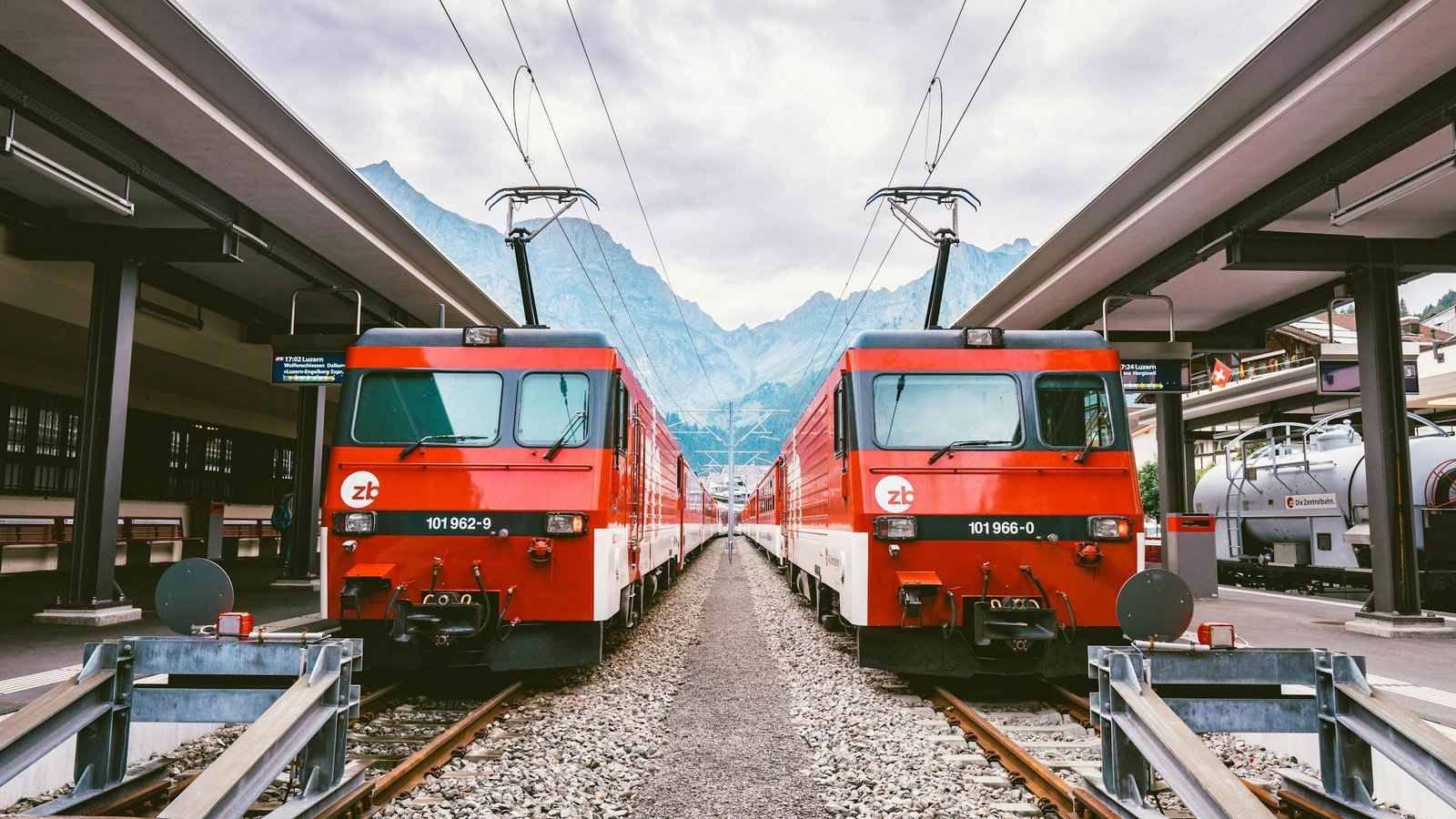
Take the train. For almost every traveller, Swiss rail is faster, cheaper and less stressful than driving. Trains reach every city, most mountain villages, and the trailheads in between. They run on time. Connections are timed so you can step off one train and onto the next.
Rent a car only if you are staying somewhere rural, travelling with small children and a lot of luggage, or planning to move around on your own schedule every day. Even then, several popular towns, Zermatt among them, do not allow cars at all.
Getting to Switzerland
By air
Three airports handle most international arrivals:
- Zurich (ZRH), the largest, and the best connected to the rest of the country.
- Geneva (GVA), best for the French-speaking west, the Valais, and Chamonix over the border.
- Basel (BSL/MLH), smaller, shared with France and Germany, good for the northwest.
Zurich and Geneva both have a train station inside the airport. You clear customs, ride an escalator down, and board. There is no separate transfer to arrange. Trains leave every few minutes.
By train from a neighbouring country
If you are already in Europe, the train is often easier than flying. Direct services run from Milan, Munich, Stuttgart, Paris and Vienna into Zurich, Basel, Geneva and Lugano. Journey times from Milan to Zurich run around three and a half hours through the Gotthard Base Tunnel.
Book these international routes in advance. Unlike domestic Swiss trains, cross-border fares rise steeply close to the departure date.
How the Swiss travel system works
This is the part most visitors miss, and it is what makes the country easy.
Swiss trains, PostBuses, lake boats and most city trams and buses are not separate companies competing with each other. They are coordinated into one network, the Swiss Travel System, running on one integrated timetable. A single ticket or pass can cover a train to a lakeside town, the boat across the lake, the bus up the valley and the tram when you get back to the city.
Connections are built into the schedule. If your train arrives at 10:04 and the bus leaves at 10:08, that is deliberate, and the bus will be waiting. Delays are rare enough that the system genuinely works this way.
You do not need to plan every leg in advance. Turn up, check the board, get on.
Which Swiss travel pass is right for you
This is the decision that actually affects your budget, and the one most guides skip. There are four realistic options.
Swiss Travel Pass
Unlimited travel on trains, buses and boats for a set number of days, sold in 3, 4, 6, 8 and 15-day versions. It also covers public transport inside most towns and cities, gives free entry to a large number of museums, and discounts most mountain railways by around half.
A Flex version lets you use your travel days spread across a month rather than consecutively, for a modest premium.
Worth it if: you are moving between regions most days, and plan to use boats and city transport as well as trains.
Half Fare Card
Roughly CHF 120, valid one month, and it cuts the price of most journeys in half, trains, buses, boats and many mountain lifts.
Worth it if: you are basing yourself in one or two places and taking a handful of longer trips. The card usually pays for itself within two or three intercity journeys.
Saver Day Pass
A dated day pass for unlimited travel on one specific day. Prices are lowest when booked well ahead and climb as the date approaches.
Worth it if: you know exactly which days you will travel long distances, and you are willing to commit early.
Point-to-point tickets and Supersaver fares
Buy individual journeys as you go. Supersaver fares attach to specific departures booked in advance and can be substantially cheaper than the standard fare, but they lock you into that train.
Worth it if: you are only making one or two long trips and want flexibility the rest of the time.
Prices and coverage change from year to year. Check current fares on the Swiss Federal Railways site before you commit to a pass, and compare the total against the actual journeys you plan to make.
The way I settled it on my own trip: I was on a train, a lake ferry or a cable car nearly every day, so the Swiss Travel Pass came out clearly ahead of buying tickets one by one. On a trip where I’d stayed put in one or two places, a Half Fare Card would have won instead. The pass only makes sense if you actually keep moving, do the sum against your real itinerary.
You can buy the Swiss Travel Pass and point-to-point tickets ahead of time online. Trip.com
Trains: what to expect
Swiss trains are clean, quiet and punctual. Most run every 30 or 60 minutes on a repeating pattern, so you rarely wait long.
A few practical points:
- Reservations are not normally required. On regular domestic trains you board with a valid ticket and sit where you like. The exceptions are the scenic panoramic routes, which do require a seat reservation.
- First and second class both work. Second class is perfectly comfortable. First class is quieter and worth it on busy weekend routes if the upgrade is small.
- Validate nothing on the train itself, your ticket or app pass is checked onboard by an inspector. Travelling without a valid ticket carries a fine, and inspections are frequent.
- Download the SBB Mobile app. Live departures, platform changes, connections and tickets all sit in one place. It is genuinely good.
- Luggage can travel separately. Swiss rail runs a station-to-station luggage service. Drop your bags in the morning, collect them at your destination. Useful if you are changing base and want a day of sightseeing in between.
Buses and boats where trains do not go
The yellow PostBuses pick up where the rail network stops. They serve mountain villages, valley floors and pass roads, and they run to the same timetable logic as the trains. If a village has no station, a PostBus almost certainly reaches it.
Lake boats are public transport too, not just excursions. Services run on Lake Lucerne, Lake Geneva, Lake Zurich, and Lakes Thun and Brienz near Interlaken. They are covered by the Swiss Travel Pass and discounted with a Half Fare Card. Taking the boat one direction and the train back is often the better way to see a lake region.
Mountain railways and cable cars
Getting up the mountains is a separate question from getting around the country, and it is where pass coverage gets complicated.
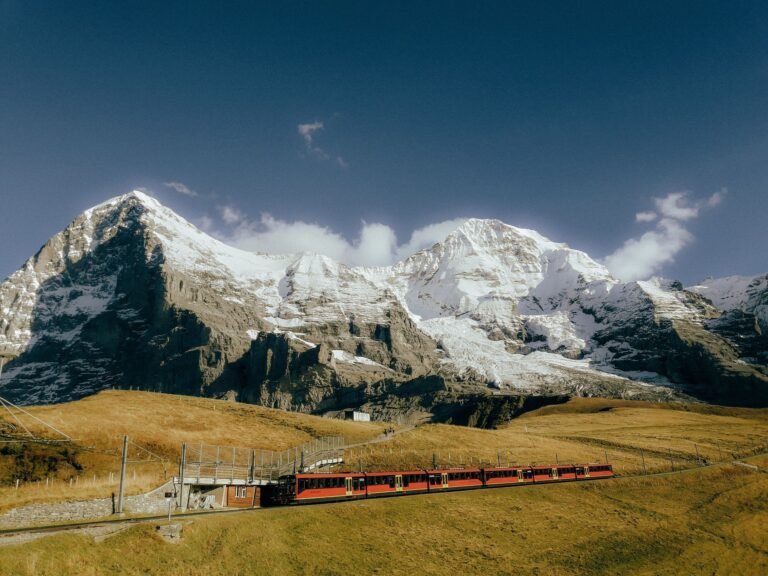
Most cogwheel railways, funiculars and cable cars are discounted rather than included with a Swiss Travel Pass, commonly by half, though it varies by operator. Some of the headline excursions, including Jungfraujoch and the lifts above Zermatt, charge a substantial fare even with a pass.
Budget for these separately. A single major mountain excursion can cost more than a day of intercity travel.
For a private day trip rather than joining a tour group, Intui.travel has a range of private options in Switzerland, including driver + guide combinations for flexible itineraries. Intui.travel
The scenic panoramic routes
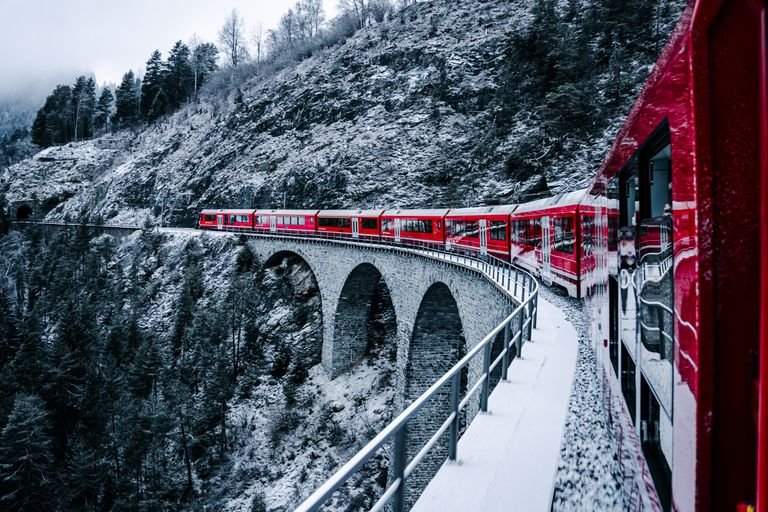
Several routes are destinations in themselves, with panoramic carriages built for the view:
- Glacier Express, St. Moritz to Zermatt, around eight hours across the southern Alps.
- Bernina Express, Chur to Tirano in Italy, over the highest rail crossing in the Alps.
- GoldenPass Line, Lucerne to Montreux, through the Bernese Oberland to Lake Geneva.
All require seat reservations on top of your ticket or pass, and they sell out in summer. If you want the Glacier Express specifically, we cover the booking process in detail in How to Book Glacier Express Seats.
Worth knowing: the same track is served by ordinary regional trains at a fraction of the cost. You see the same scenery through a normal window, with the freedom to break the journey.
Heading to Zermatt? Zermatt Without a Car →
Getting around cities
Swiss cities are compact and walkable. Zurich, Geneva, Bern, Basel and Lucerne all have dense tram and bus networks, and you will rarely wait more than a few minutes.
One thing worth asking about at check-in: many towns issue a guest card to overnight visitors, which covers local transport for the length of your stay. It is often free and frequently unmentioned unless you ask.
Should you rent a car?
Usually not. But if you do, know these things first:
- You need a motorway vignette, a sticker for the windscreen, around CHF 40, valid for the calendar year. Rental cars registered in Switzerland normally have one already. Driving on the motorway without it carries a fine.
- Several towns are car-free. Zermatt, Wengen, Mürren, Saas-Fee, Braunwald and Stoos among them. You park in a valley station and take a train or cable car up.
- Mountain passes close in winter. Routes that look direct on a map may be shut from roughly October to May, adding hours to a drive.
- Parking in Alpine towns is limited and expensive. Factor it into the cost comparison.
If your trip is city-to-city, or centred on the Alps, the car will spend most of its time parked while you take the train anyway.
What it actually costs
Switzerland is expensive, and transport is no exception. A one-way intercity fare between major cities typically runs into the tens of francs at full price, which is why the Half Fare Card pays for itself quickly.
The practical approach: list the journeys you actually intend to make, price them individually on the Swiss Federal Railways site, then compare that total against a Swiss Travel Pass and against a Half Fare Card plus discounted fares. One of the three will be clearly cheaper for your itinerary. Fares change, so run this check close to your travel dates rather than relying on figures from an older guide.
Frequently asked questions
What is the best way to get around Switzerland?
Train, for almost everyone. The network reaches nearly everywhere worth going, runs frequently, and connects with buses and boats on a single timetable. A car only makes sense for rural bases or highly flexible daily plans.
Do I need to book Swiss train tickets in advance?
Not for normal domestic trains, you can buy on the day and board without a reservation. Book ahead only for the scenic panoramic routes, which require seat reservations, or to get discounted Supersaver fares on a specific departure.
Is the Swiss Travel Pass worth it?
It depends entirely on how much you will move around. If you are changing region most days and using boats and city transport too, it usually wins. If you are basing yourself in one or two places, a Half Fare Card plus individual tickets is normally cheaper. Price your actual itinerary both ways.
How do I get from Zurich Airport to the Alps?
By train, directly from the station beneath the airport. Lucerne takes around an hour, Interlaken around two, and Zermatt requires one change at Visp onto the narrow-gauge line. We cover that route in detail in How to Get from Zurich to Zermatt.
Can I drive to Zermatt?
No. Zermatt is car-free. You drive or take the train to Täsch and continue by shuttle train from there.
Are Swiss trains really that punctual?
Yes. Tight connections are scheduled deliberately and generally hold. If a connection does fail, staff will route you onward, ask at the platform or the station desk.
Where to go next
If you are still deciding whether Switzerland belongs on your list, start with Why Visit Switzerland. If you have already booked and want to build days around Zurich, see Day Trips from Zurich. Everything we have written on the country sits on the Europe hub.
This article is for informational and educational purposes only. Always verify current travel requirements with official government sources before making travel decisions.
Partner resource. We may earn a commissionCompare Swiss rail passes & tickets (Trip.com) → Partner resource. We may earn a commissionBook transfers & local transport (Intui.travel) →