
Note: This site participates in the Amazon Affiliates and other affiliate partner programs at no cost to you. Visiting an affiliate partner site may result in this site receiving a commission. For more information visit our Affiliate Disclosure page.
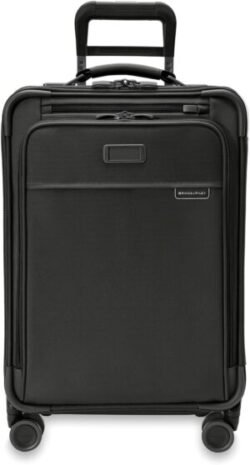
Briggs & Riley makes some of the most durable carry-on luggage on the market, backed by a lifetime warranty that covers airline damage. It is also expensive. This guide covers what you are actually paying for, how the two main carry-on lines differ, and who should buy one.
The short answer
If you fly often enough that luggage is a recurring cost, a Briggs & Riley carry-on is a buy-it-once bag. The Simple as that warranty repairs any damage for life, free, with no receipt needed, even when an airline caused it. That is the real reason to pay the premium.
If you travel a few times a year, a mid-priced carry-on from a mainstream brand will do the same job for a fraction of the price. The Briggs & Riley advantage only pays off over years of heavy use.
Softside or hardside
Briggs & Riley splits its carry-ons into two lines that suit different travellers.
| Baseline (softside) | Torq (hardside) | |
| Shell | Ballistic nylon, water-resistant | 100% polycarbonate, sealed |
| Handle | Outsider handle mounted outside the case, so the packing surface stays flat | Internal handle, standard tapered packing space |
| Expansion | CX compression-expansion adds capacity, then compresses to fit a bin | Fixed or expandable depending on model |
| Best for | Packing efficiency, forgiving in a tight overhead bin, quiet on the road | Maximum protection for fragile items, wipe-clean shell, a more finished look |
The Outsider handle is the signature Baseline feature. Because the telescoping handle sits on the outside of the case, the inside is a flat rectangle with no handle bars pushing up through your clothes. If you pack in packing cubes and want everything to lie flat, this matters. If you mostly carry structured items, it matters less.
Two wheels or four
Both lines come in two-wheel and four-wheel (spinner) versions.
- Two-wheel. The recessed wheels sit inside the case footprint, so the bag holds slightly more and rolls better over cobbles, kerbs and gravel. You tilt and pull it.
- Four-wheel spinner. Rolls upright beside you and turns in place, which is easier in an airport and a train aisle. The wheels protrude, costing a little packing space, and they are less happy on rough ground.
For trips that are mostly airports and smooth floors, choose the spinner. For trips through European old towns and train stations, the two-wheel version is the steadier choice.
Packing carry-on only? What to Pack for European Countries →
A note on size and price
Briggs & Riley carry-ons are built to the US domestic standard of roughly 22 x 14 x 9 inches. Many international carriers and most low-cost airlines are stricter, often 55 x 40 x 20 cm or less, and some weigh the bag. An expandable carry-on that fits a US bin when expanded may not fit a European budget carrier at all. Check your specific airline before you fly, and pack within the compressed dimensions if you are flying internationally.
Prices run into the several hundreds of dollars and move around with sales and model years. Check the current figure on the product page rather than relying on a number in an older review.
You can see current Briggs & Riley carry-on models and prices here. Briggs & Riley on Amazon
Is the warranty really that good?
By reputation, yes. For structural damage Briggs & Riley arranges collection, repair and return shipping at no cost, and does not ask for proof of purchase. Wheels, handles, zips and seams are all covered for the life of the bag. This is the part of the value proposition that mid-priced brands cannot match, and it is what makes the bag worth considering if you travel enough to wear luggage out.
What I would do
I travel carry-on only and move between cities by train, where a compact bag with good wheels earns its place on station stairs and narrow aisles. If you are in that pattern and expect to be for years, a Briggs & Riley two-wheel Baseline carry-on is a sound long-term buy. If your travel is lighter than that, put the money toward the trip and buy a mid-priced bag you will not mind replacing eventually.
Frequently asked questions
Is Briggs & Riley worth the money?
For frequent travellers, yes. The lifetime warranty covers airline damage with no receipt required, which offsets the high purchase price over years of use. For occasional travellers, a mid-priced carry-on is the better value.
What is the difference between the Baseline and Torq carry-ons?
Baseline is softside ballistic nylon with the external Outsider handle and CX expansion. Torq is a sealed polycarbonate hardside. Choose Baseline for packing efficiency and flexibility, Torq for protecting fragile items and a wipe-clean shell.
Does the Briggs & Riley warranty cover airline damage?
Yes. The Simple as that guarantee repairs damage for the life of the bag, free of charge, even when an airline caused it, and without proof of purchase.
Will a Briggs & Riley carry-on fit international carry-on limits?
Not always. The bags are sized to the US domestic standard. International and low-cost carriers are often stricter on both size and weight, so confirm your airline’s limit and pack within the compressed dimensions when flying internationally.
Where to go next
Building out the rest of your kit? See our crossbody sling bag guide for the personal item you carry alongside a carry-on, the backpack comparison if you would rather carry than roll, and the European packing list for what actually goes inside.
This article is for informational and educational purposes only. Always verify current travel requirements with official government sources before making travel decisions.